 RoadTick guide
Hazard Perception Test Tips: How to Score 44+ Out of 75
By Muhammad Shahid Khan · · 5 min read
Quick answer
Click as soon as you see a hazard start to develop, the moment it would make a driver slow down or change direction, then click once or twice more as it develops. Each of the 15 hazards scores up to 5 points, and the pass mark is 44 out of 75. Clicking constantly or in a rhythm scores zero for that clip.
RoadTickHazard Perception & Mock Tests · Free on the App StoreDownload free →| Clips | 14 (one contains two hazards) |
|---|---|
| Scoreable hazards | 15 |
| Points per hazard | 0 to 5, depending on how early you respond |
| Pass mark | 44 out of 75 |
| Penalty | Clicking constantly or in a pattern scores 0 for that clip |
Hazard perception is the part of the theory test that surprises people. You can know the Highway Code by heart and still fail it, because it does not test knowledge. It tests timing. The good news is that timing can be trained, and once you understand how the scoring works, it gets much easier.
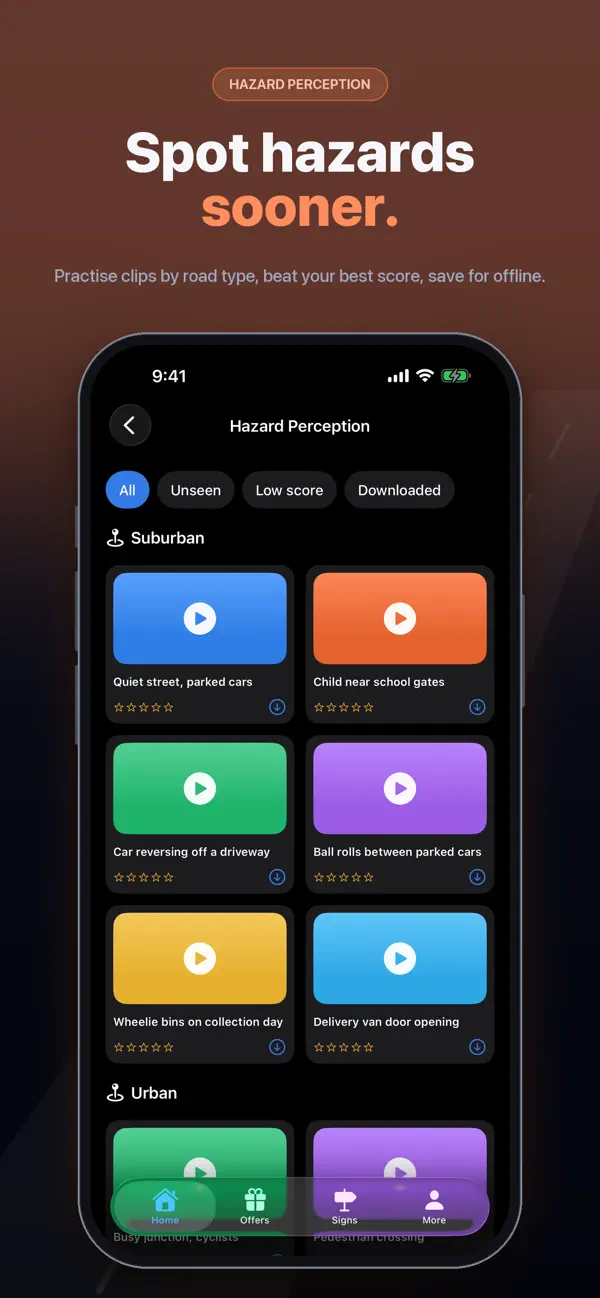
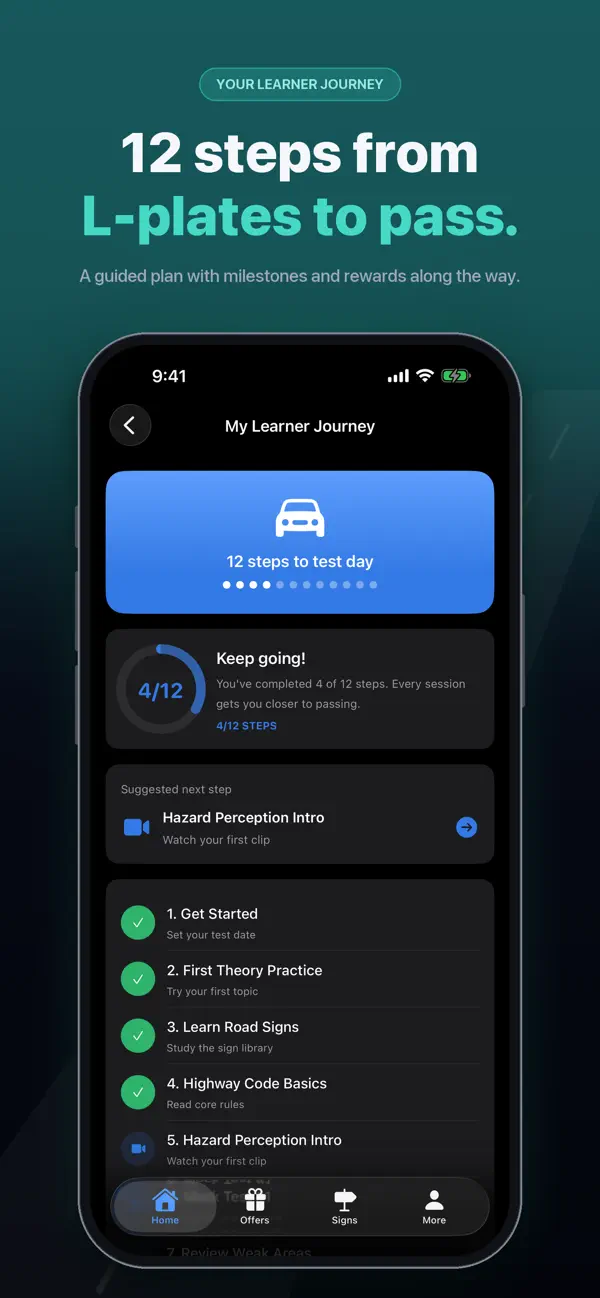
I build RoadTick: Driving Theory Test, a free UK theory test app for iPhone and iPad, and the screenshots in this guide come from it. If you want to practise as you read, get RoadTick on the App Store.
What counts as a developing hazard?
A developing hazard is something that would make you, as the driver, take action by slowing down, stopping or changing direction. That is the key distinction:
- A parked car is a potential hazard. You do not need to act.
- A parked car whose reversing lights come on, or whose driver opens the door, is a developing hazard. Now you would need to act.
You score points for the developing hazard. Clicking for potential hazards does not lose points (unless you click excessively), but it does not earn any either.
How is hazard perception scored?
Each developing hazard has a scoring window that starts when the hazard begins to develop. The window is split into five parts:
| When you click | Points |
|---|---|
| First part of the window (earliest) | 5 |
| Second part | 4 |
| Third part | 3 |
| Fourth part | 2 |
| Fifth part (latest) | 1 |
| Before the window, or after it ends | 0 |
Only your best click within the window counts. That is why a common technique is to click once when you first notice something, and again a moment later as it develops. If your first click was too early, the second one lands inside the window.
Why does clicking too much score zero?
The test detects clicking that looks like guessing: rapid repeated clicks, or clicks in a regular rhythm. If it detects this, you score zero for that clip and are shown a message at the end of the clip. Two or three deliberate clicks per hazard are fine. Ten clicks in a row are not.
10 tips to pass hazard perception
- Watch the whole scene, not just the road ahead. Hazards often come from the edges: pavements, side roads, driveways and parked cars.
- Look for clues before the hazard. A ball in the road, an ice-cream van, a bus at a stop, or a school sign all suggest something is about to happen.
- Click when you would act, not when you first see something. Ask yourself: "Would I slow down now?"
- Use the two-click technique. Click once when you spot it and once more as it develops.
- Do not click in a rhythm. Space clicks naturally.
- Remember one clip has two hazards. Do not relax after the first one. Keep watching until the clip ends.
- Pay attention to vulnerable road users. Cyclists, pedestrians, horse riders and motorcyclists are common hazards.
- Watch junctions closely. Vehicles emerging from side roads are among the most common developing hazards.
- Practise regularly, not all at once. Short daily sessions build the instinct better than one long session.
- Review your scores. If you keep scoring 1 or 2, you are reacting late. If you score 0 with no warning, you are probably clicking too early.
How many points do I need per clip?
The pass mark is 44 out of 75, an average of about 3 points per hazard. You do not need to be perfect. Scoring 3 or 4 on most hazards, with an occasional 5, is a comfortable pass. Missing a hazard completely costs a lot, so concentrate on not missing anything rather than chasing 5s.
When should I start practising?
From the beginning of your revision. Hazard perception is a reaction skill, so it develops over weeks rather than days. Mix a few clips into each study session alongside your theory questions. For the full plan, see the UK driving theory test guide, and for how to use mocks in your last week, see driving theory mock test strategy.
More guides you may find useful:
- Theory Test Day: What to Bring, What Happens and What to Expect
- UK Roundabout Rules: Lanes, Signals and Mini-Roundabouts Explained
- UK Stopping Distances for the Theory Test: Chart, Car Lengths and an Easy Way to Remember
How RoadTick helps
- Practice questions for every theory topic, each with a plain-English explanation.
- Timed mock tests in the real format: 50 questions in 57 minutes, scored against the pass mark of 43.
- Hazard perception practice to build the timing the second part tests.
- The Highway Code broken into short sections that are easy to revise.
- UK road signs and markings with clear images and meanings.
- Progress tracking that shows which topics still need work before you book.
Download RoadTick free on the App Store and turn spare minutes into theory test practice. RoadTick is an independent app and is not affiliated with the DVSA.
Frequently asked questions
What is the pass mark for hazard perception?
44 out of 75.
How many clips are in the hazard perception test?
14 video clips. One of them contains two developing hazards, so there are 15 scoreable hazards in total.
How many points can I score per hazard?
Up to 5 points per hazard. The earlier you click once the hazard starts to develop, the higher the score.
What is a developing hazard?
Something that would make you take action as a driver, such as slowing down, stopping or changing direction. A parked car is a potential hazard. A parked car pulling out is a developing hazard.
Can I lose points for clicking too much?
Yes. If you click constantly or in a pattern, you score zero for that clip.
How many times should I click for each hazard?
Two or three deliberate clicks is a common technique: one when you spot it and one or two as it develops.
Do I lose points for clicking on potential hazards?
No, as long as you are not clicking excessively. Those clicks just do not score.
Can I replay a hazard perception clip?
No. In the real test, each clip plays once.
Are the hazard perception clips real video?
The real test uses computer-generated imagery (CGI) clips that look like real road scenes, in different weather and lighting.
Why did I score zero on a clip?
Either you clicked too early (before the scoring window opened and not again afterwards), too late, or the system detected a clicking pattern.
Do I need to pass hazard perception and multiple choice together?
Yes. Both parts must be passed in the same sitting.
Does RoadTick include hazard perception practice?
Yes. RoadTick includes hazard perception training to build the reaction skills the test looks for.
RoadTickDownload free