 UK Test Prep guide
British History Timeline for the Life in the UK Test: Every Key Date in Order
By Muhammad Shahid Khan · · 6 min read
Quick answer
The history chapter runs from the Stone Age to the present. The dates that matter most are AD 43 (Roman invasion), 1066 (Norman Conquest), 1215 (Magna Carta), 1588 (Spanish Armada), 1603 (union of the crowns), 1649 (execution of Charles I), 1707 (Act of Union with Scotland), 1801 (Ireland joins), 1914 to 1918 and 1939 to 1945 (World Wars), and 1948 (the NHS).
UK Test PrepCitizenship, ILR & Visa Prep · Free on the App StoreDownload free →| Roman invasion | AD 43, under Emperor Claudius |
|---|---|
| Norman Conquest | 1066, Battle of Hastings |
| Magna Carta | 1215, King John |
| Kingdom of Great Britain | 1707, Act of Union |
| United Kingdom of Great Britain and Ireland | 1801 |
| NHS founded | 1948 |
History is the largest chapter of the Life in the UK handbook and the one most people find hardest. The trick is to learn it as a story in order, so each date hangs on the one before it, instead of as a list of disconnected numbers. Here is the whole timeline, period by period, with the facts the test asks about most.
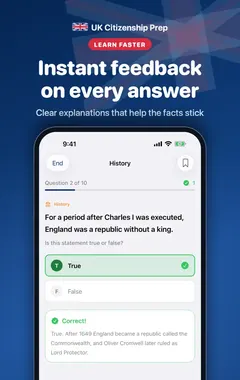
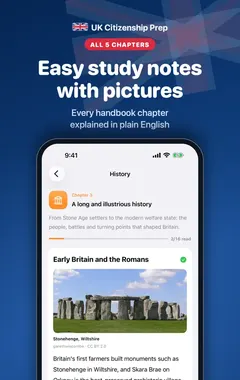
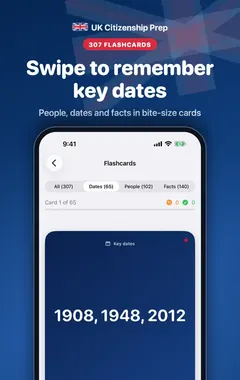
I build UK Test Prep, a free iPhone and iPad app for the Life in the UK test, and the screenshots in this guide come from it. If you want to test yourself as you read, get UK Test Prep on the App Store.
Every fact here comes from the official handbook, Life in the United Kingdom: A Guide for New Residents (3rd edition). For the facts people get wrong most often, see the hardest Life in the UK test topics.
Early Britain: Stone Age to the Romans
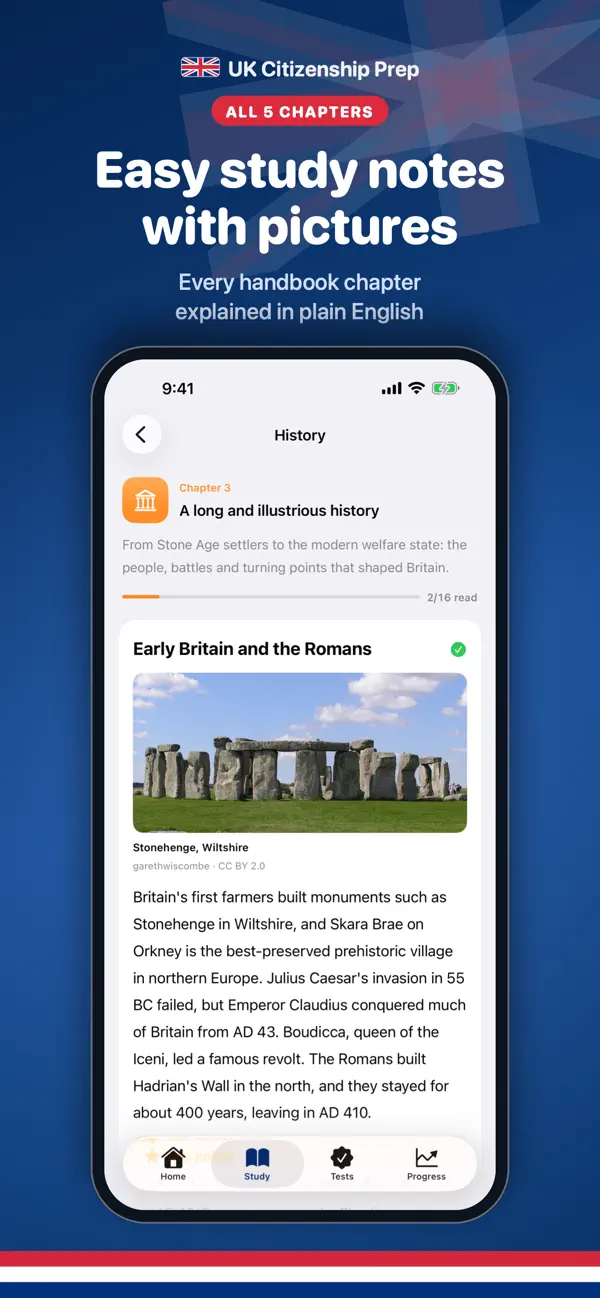
- Stone Age: the first farmers built Stonehenge in Wiltshire and Skara Brae on Orkney, the best-preserved prehistoric village in northern Europe.
- Bronze Age: people buried their dead in round barrows.
- Iron Age: hill forts such as Maiden Castle in Dorset; the first coins were made in Britain.
- 55 BC: Julius Caesar led an invasion, which failed.
- AD 43: Emperor Claudius led the Roman invasion. Boudicca, queen of the Iceni, fought against the Romans.
- Hadrian's Wall was built to keep out the Picts. The Romans stayed for about 400 years and left in AD 410.
Anglo-Saxons, Vikings and the Normans
- Anglo-Saxons settled after the Romans left. The ship burial at Sutton Hoo in Suffolk is probably that of a king of East Anglia.
- Christian missionaries: St Patrick in Ireland, St Columba on Iona, St Augustine in the south of England.
- AD 789: the Vikings first raided. Alfred the Great united the Anglo-Saxon kingdoms to defeat them.
- Kenneth MacAlpin united the Picts and Scots, the start of the kingdom of Scotland.
- 1066: William, Duke of Normandy, defeated King Harold at the Battle of Hastings. The Bayeux Tapestry shows the battle. William ordered the Domesday Book.
The Middle Ages
- 1215: King John was forced to agree to the Magna Carta, which limited the king's power.
- 1284: the Statute of Rhuddlan annexed Wales to the English Crown.
- 1314: Robert the Bruce defeated the English at the Battle of Bannockburn.
- 1348: the Black Death killed about a third of the population of England.
- 1415: Henry V won the Battle of Agincourt during the Hundred Years War.
- 1455 to 1485: the Wars of the Roses, ending at the Battle of Bosworth Field, when Henry Tudor became Henry VII.
- Culture: Geoffrey Chaucer wrote The Canterbury Tales; William Caxton was the first person in England to print books.
The Tudors and Stuarts
- Henry VIII had six wives and broke from Rome to create the Church of England.
- Elizabeth I reigned when the English defeated the Spanish Armada in 1588. Shakespeare wrote in her reign.
- 1603: James VI of Scotland became James I of England, uniting the crowns. The King James Bible followed.
- 1642: the English Civil War began between Cavaliers (the king) and Roundheads (Parliament).
- 1649: Charles I was executed. England became a republic, with Oliver Cromwell as Lord Protector.
- 1660: the Restoration: Charles II became king.
- 1665 and 1666: the Great Plague, then the Great Fire of London.
- 1679: the Habeas Corpus Act.
- 1688: the Glorious Revolution: William of Orange took the throne. The Bill of Rights followed in 1689.
Great Britain, empire and industry
- 1707: the Act of Union created the Kingdom of Great Britain.
- 1721 to 1742: Sir Robert Walpole, the first Prime Minister.
- 1745: Bonnie Prince Charlie's rising, defeated at Culloden in 1746.
- 1801: the Act of Union created the United Kingdom of Great Britain and Ireland.
- 1807: the slave trade was abolished; 1833: slavery was abolished throughout the British Empire. William Wilberforce led the campaign.
- 1832: the Reform Act extended the vote.
- 1837 to 1901: the reign of Queen Victoria, the age of the Industrial Revolution and the British Empire.
- 1853 to 1856: the Crimean War, where Florence Nightingale transformed nursing.
The 20th century
- 1914 to 1918: the First World War. The Battle of the Somme in 1916 cost about 60,000 British casualties on the first day. The war ended on 11 November 1918.
- 1918: women over 30 gained the vote; 1928: women could vote at 21, the same as men.
- 1922: Ireland was divided; the south became independent.
- 1939 to 1945: the Second World War, with Winston Churchill as Prime Minister from 1940. Dunkirk and the Battle of Britain in 1940; D-Day on 6 June 1944.
- 1948: the NHS was founded, with Aneurin Bevan as Minister for Health.
- 1969: the voting age was lowered to 18.
- 1979: Margaret Thatcher became the first woman Prime Minister.
- 1998: the Good Friday Agreement in Northern Ireland.
- 1999: the Scottish Parliament and the Welsh Assembly were created.
How do I remember all these dates?
- Learn the order first, then the numbers: Romans, Anglo-Saxons, Vikings, Normans, Middle Ages, Tudors, Stuarts, Georgians, Victorians, 20th century.
- Anchor dates: 43, 1066, 1215, 1603, 1707 and 1801. Place everything else before or after them.
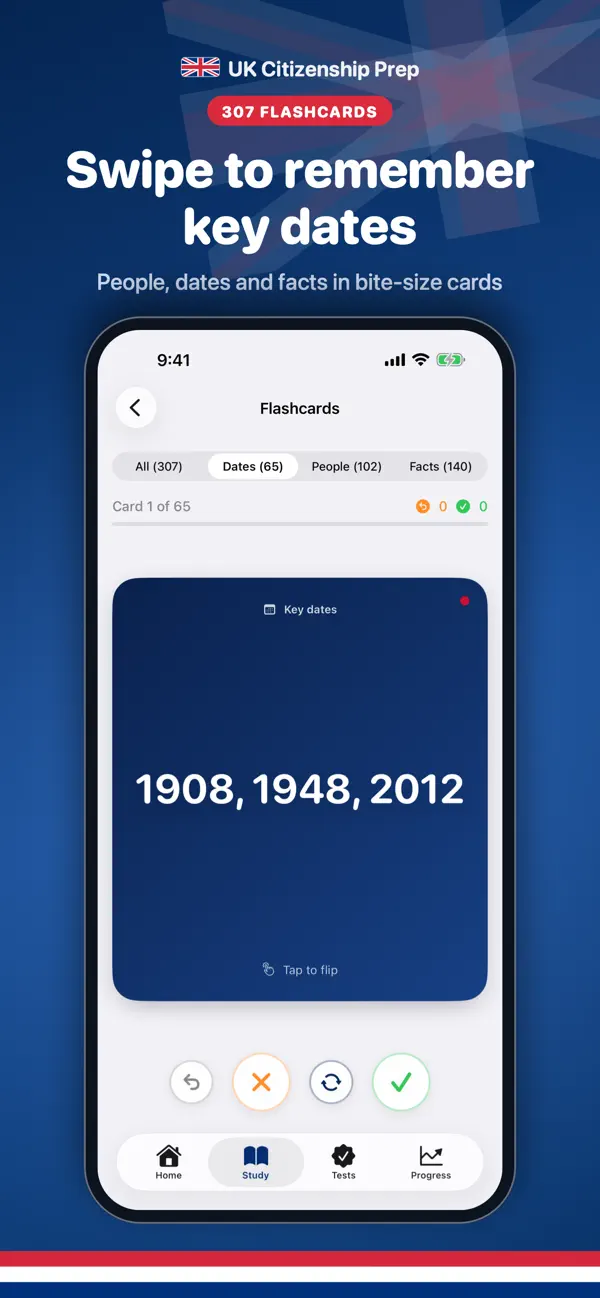
- Flashcards daily, five minutes at a time, rather than one long session.
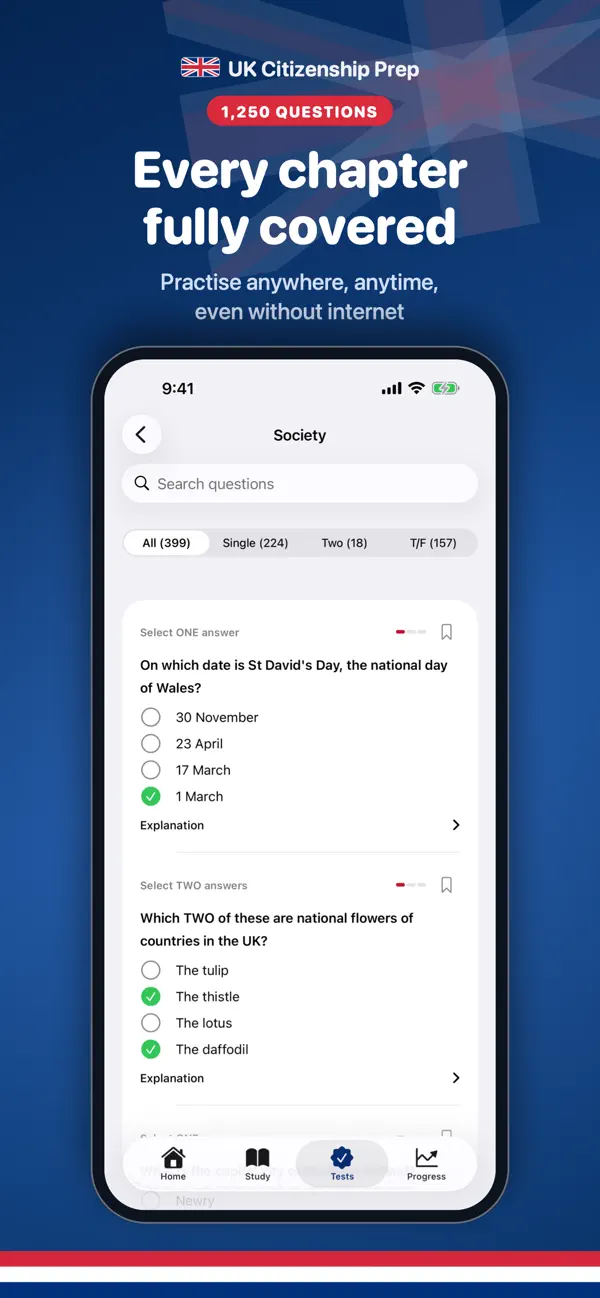
- Test yourself with history questions after each period.
A day-by-day plan is in the 4-week Life in the UK study plan.
How UK Test Prep helps
- 1,250 original practice questions across all five handbook chapters, each with an explanation.
- 46 study note sections written from the official handbook.
- 307 flashcards for the dates, people and facts that need memorising.
- A realistic mock exam: 24 questions, a 45-minute timer and the 18-mark pass line.
- A weak-areas list, readiness score, streaks and progress by chapter.
- Works fully offline, with no account. Every feature is free; an optional purchase removes ads.
Download UK Test Prep free on the App Store and pass the Life in the UK test first time. UK Test Prep is independent and not affiliated with the UK Government or the Home Office.
Frequently asked questions
When did the Romans invade Britain?
In AD 43, under Emperor Claudius. They left in AD 410.
What happened in 1066?
William, Duke of Normandy, defeated King Harold at the Battle of Hastings: the Norman Conquest.
When was the Magna Carta signed?
In 1215, by King John.
When was the Battle of Bannockburn?
In 1314, when Robert the Bruce defeated the English.
When were the crowns of England and Scotland united?
In 1603, when James VI of Scotland became James I of England.
When was the English Civil War?
It began in 1642. Charles I was executed in 1649.
When was the Act of Union with Scotland?
In 1707, creating the Kingdom of Great Britain.
When did Ireland join the United Kingdom?
In 1801, under the Act of Union.
When was slavery abolished in the British Empire?
In 1833. The slave trade itself was abolished in 1807.
When did women get the vote?
Women over 30 in 1918, and at 21, the same as men, in 1928.
When was the NHS founded?
In 1948.
How do I remember Life in the UK history dates?
Learn the periods in order, anchor key dates like 1066, 1215 and 1707, and review flashcards daily. UK Test Prep has 307 flashcards for dates, people and facts.
UK Test PrepDownload free